A clearer way to see who in your organisation can lead through what comes next.
Every leadership team is asking a version of the same question. When the work keeps changing, when the roles we're hiring for don't look like the roles we hired for five years ago, how do we know who can adapt, who can lead through it, and where the risk sits?
The Agility Quotient was built to answer that question. AQ measures learning agility across nine validated facets, gives you a single composite score that quantifies leadership readiness, and shows you the picture for one candidate or your whole workforce in one view. The science is published. The method is human authored throughout. The output is built to be read, used, and trusted.
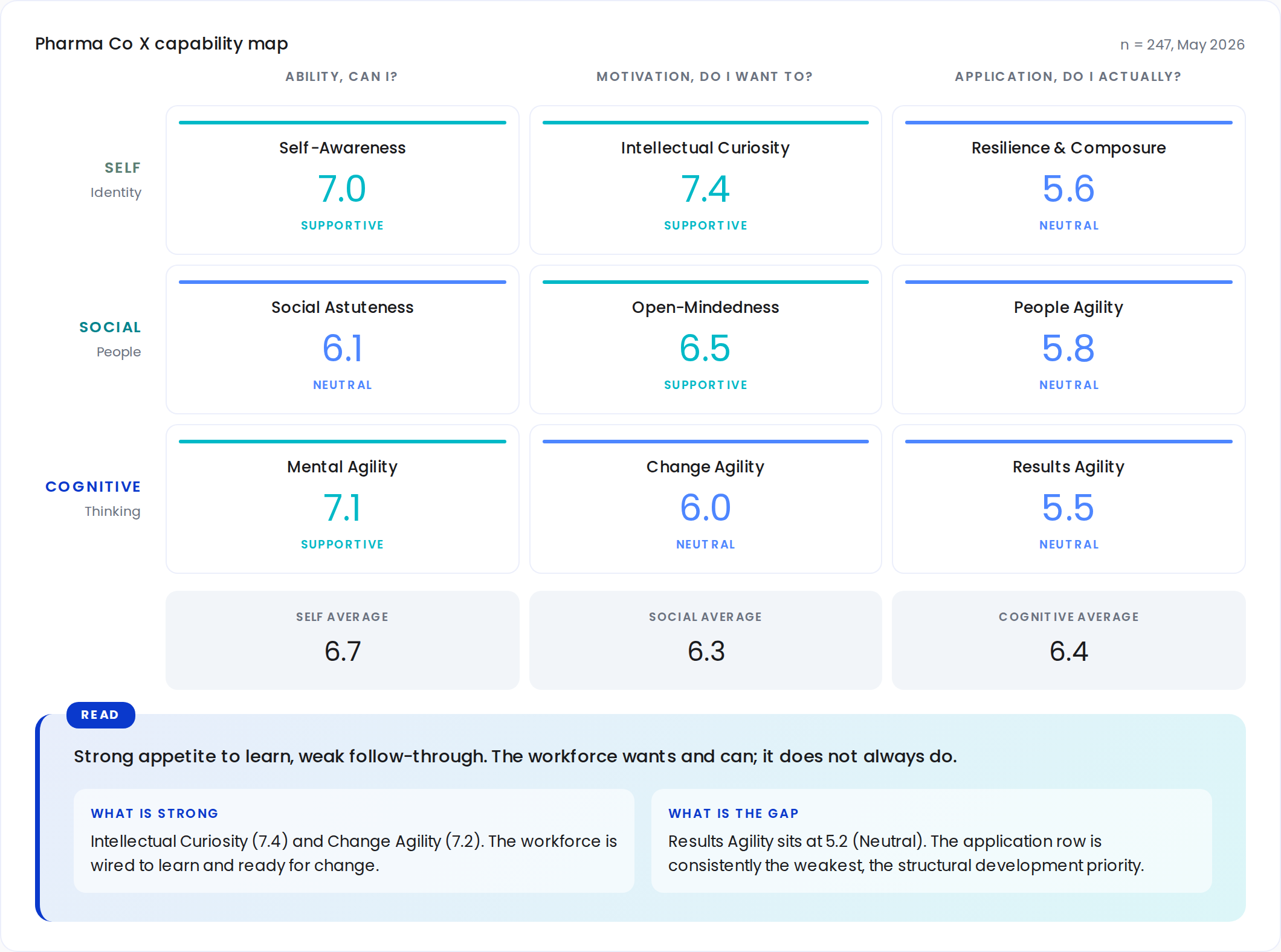
Learning agility is the capacity to learn from experience, adapt to new situations, and apply that learning to lead through complexity. AQ measures it across nine facets, organised by domain (cognitive, social, self) and by mode (ability, motivation, application). The result is a profile that tells you whether someone is agile, and how their agility shows up.
Backed by De Meuse (2022) and validated against the leadership agility literature.
Individual reports tell you about one person. The Workforce Dashboard tells you about your organisation. Filter by team, function, or seniority. Spot patterns. See where strength clusters and where risk concentrates. Drill into individuals when you need to.
This is what you see when the question is no longer about a single hire, but about whether the leadership bench is ready for what's next.
Every AQ engagement produces three connected reports, each written for a different reader. The Development report supports the conversation between a manager and a direct report. The Selection report supports hiring and succession decisions. The Candidate report goes to the individual, in language designed for them. All three are generated from the same data, by the same engine, with narrative authored by occupational psychologists.
Five steps, designed to keep you out of the operational detail.
The World Economic Forum's Future of Jobs Report 2025 quantifies what every leadership team is already feeling. 22% of jobs structurally disrupted by 2030. 39% of core skills changed in five years. 59 in 100 workers needing reskilling. The single biggest differentiator between growing and declining roles is not technical skill: it is resilience, flexibility, and the capacity to learn through change.
Eight of the WEF's ten most critical skills for 2030 map directly to facets in the AQ framework. That is not a coincidence.
AQ is built on a deterministic engine with narrative authored by occupational psychologists. No generative AI sits in the data path. The same input produces the same output, every time, and every claim in every report can be traced back to its source.
If you'd like to explore AQ for your organisation, a conversation is the best place to start. We'll talk through the question you're trying to answer, walk you through the dashboard live, and help you decide whether AQ is the right fit.