Agility Quotient

Enabling workforces to thrive in a changing world.

A clearer way to see who in your organisation can grow into what comes next.

Every leadership team is asking a version of the same question. When the work keeps changing, when the roles we're hiring for don't look like the roles we hired for five years ago, how do we know who can adapt, who can grow with it, and where the risk sits?

The Agility Quotient was built to answer that question. AQ measures learning agility across nine validated facets, gives you a single composite score that quantifies a person's readiness for change, and shows you the picture for one candidate or your whole workforce in one view. The science is published. The method is human authored throughout. The output is built to be read, used, and trusted.

What AQ measures

Nine facets. Three domains. One score.

Learning agility is the capacity to learn from experience, adapt to new situations, and apply that learning to perform through complexity. AQ measures it across nine facets, organised by domain (cognitive, social, self) and by mode (ability, motivation, application). The result is a profile that tells you whether someone is agile, and how their agility shows up.

Cognitive
Self
Ability
f1
Mental Agility
Sees patterns, makes sense of complexity.
f2
People Agility
Reads people, adapts the approach.
f3
Self-Awareness
Knows where they end and the role begins.
Motivation
f4
Intellectual Curiosity
Pulls toward the unfamiliar.
f5
Open-Mindedness
Holds other views without defending.
f6
Resilience & Composure
Steady under pressure.
Application
f7
Change Agility
Moves first when conditions shift.
f8
Social Astuteness
Reads the room, lands the message.
f9
Results Agility
Turns insight into outcome.
A small note on how to read this The grid is not just nine boxes. Read it across the rows (ability, motivation, application) to see where someone stops, and down the columns (cognitive, social, self) to see where their natural strength sits. Patterns across rows and columns tell the real story.

Backed by De Meuse (2022) and validated against the learning agility literature.

AQ Profiles

Nine scores become one recognisable shape.

A profile reads the nine facets together and names the pattern they form. Not a label and not a verdict, a shape: which domain a person leads from, and how their readiness is ordered across ability, motivation, and application. Two people with similar scores can carry very different shapes, and the shape is what tells you how to deploy them and where to develop them.

Worked example
The Explorer
Motivation-Led · Application-Building

This profile tends to lead with a strong inner foundation, steady under pressure and quick to engage with new ideas. Motivation runs ahead of consistent delivery, so the appetite and the thinking are in place before the follow-through is. The fastest gain is finishing fewer things, visibly.

Anchored in Self
Self
Social
Cognitive
Readiness order
MotivationAbilityApplication
Axis one
Domain anchor
Which domain holds the profile up. Cognitive (how they think), Social (how they connect), or Self (how they know themselves). The anchor is what tends to stay steady when the pressure is on.
Cognitive Self
Axis two
Readiness signature
How ability, motivation, and application stack up. Whether someone wants it before they can do it, or can do it before they reliably do. Each ordering reads as a developmental position, not a grade.
Ability Motivation Application
The eight AQ Profiles
The Pioneer
Motivation-Led · Ability-Building
Appetite for growth tends to run ahead of the underlying capability. First in, learns by moving. Stretch with scaffolding lets the capability catch the ambition.
The Strategist
Ability-Led · Application-Building
Capability leads, not yet fully expressed in results. Thinks ahead of the field; the edge is converting insight into delivered outcomes.
The Specialist
Ability-Led · Motivation-Building
Capability that the drive to apply it has not yet caught up with. Deep and reliable in the known; the edge is appetite for new stretch.
The Cornerstone
Application-Led · Motivation-Building
Reliable delivery that tends to run ahead of appetite for new stretch. A steadying presence; the edge is wanting the next unfamiliar thing.
The Builder
Application-Led · Ability-Building
Delivers, sometimes near the edge of current capability. Gets things moving first; the edge is deepening the capability the delivery draws on.
The All-Rounder
Balanced Profile
Capability, motivation, and application sit close together. A learn, want, do shape with no single loud signal; development is about choosing a deliberate spike.
The Mosaic
Contrast Profile
High contrast inside the domains rather than one ordered shape. Strengths and gaps sit side by side; the read is facet by facet, not headline first.

Six ordered shapes plus two structural ones, assigned deterministically from the blended nine-facet grid. Each is neutral in valence: it describes how a person's agility is arranged, not how much of it they have. The domain anchor then qualifies the shape, so two Explorers anchored in different domains read differently.

What a profile changes
For the individual
A starting point, not a scorecard
The shape points the development: what to lean into and what to let go, so the conversation starts from a recognisable pattern rather than nine separate numbers. The Explorer needs finishing discipline, not more motivation, and naming that early is the difference between coaching the right thing and coaching everything.
For the team
Composition you can see
Profiles aggregate. A team built mostly from one shape tends to carry that shape's blind spot into every decision. The dashboard reads the spread of profiles across a group, so who to add and who to deploy where becomes a question of mix, not just headcount. The read stays structural, about the composition, never about named individuals.
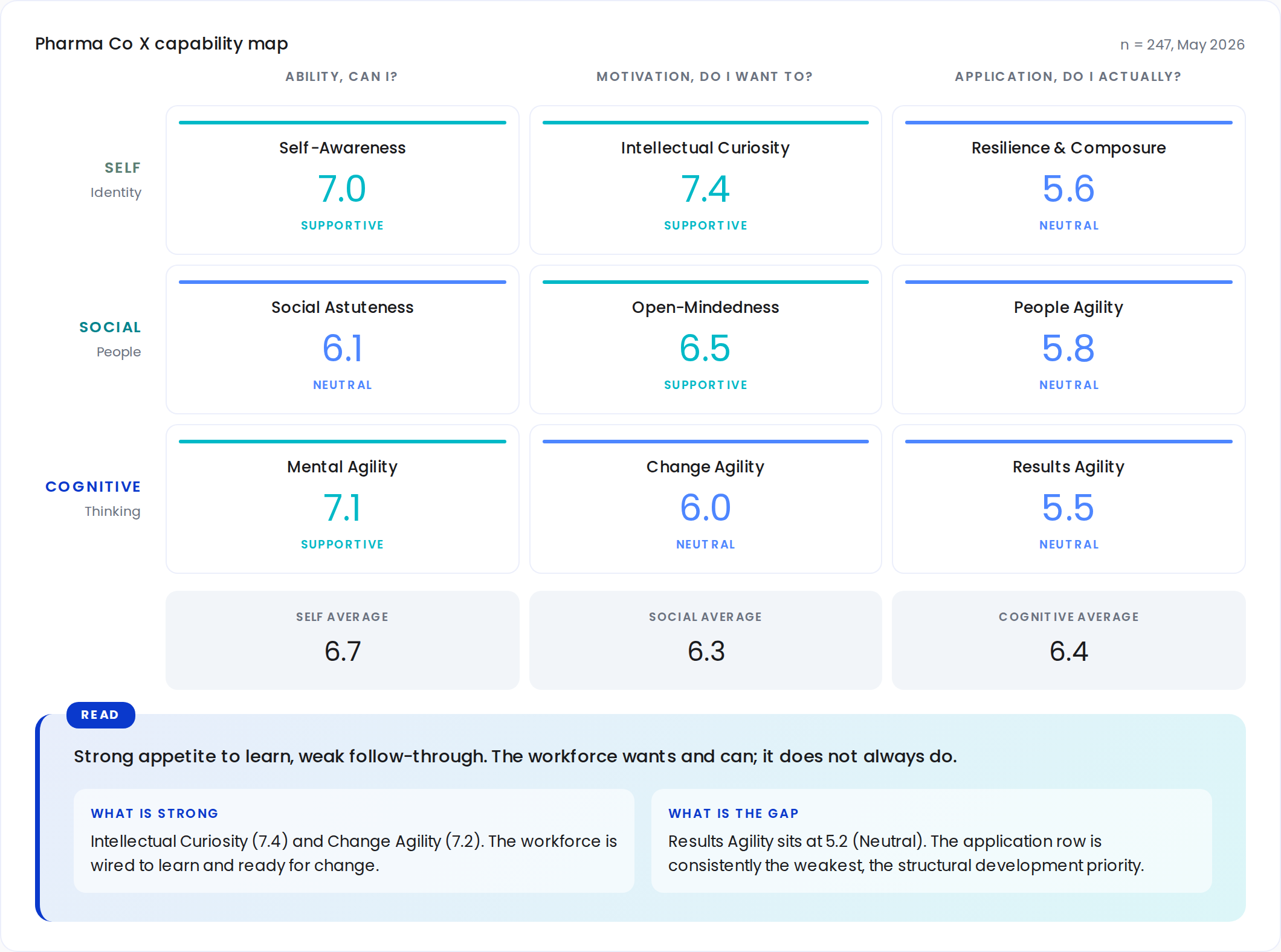
Workforce dashboard

One view of your entire workforce.

Individual reports tell you about one person. The Workforce Dashboard tells you about your organisation. Filter by team, function, or seniority. Spot patterns. See where strength clusters and where risk concentrates. Drill into individuals when you need to.

This is what you see when the question is no longer about a single hire, but about whether your people are ready for what's next.
What you get back

Three reports. One story.

Every AQ engagement produces three connected reports, each written for a different reader. The Development report supports the conversation between a manager and a direct report. The Selection report supports hiring and succession decisions. The Candidate report goes to the individual, in language designed for them. All three are generated from the same data, by the same engine, with narrative authored by occupational psychologists.

Each report now opens with the candidate's AQ Profile: the same shape, read three ways for three readers.

Development
For the conversation
Manager and direct report
Use it when building a development plan, identifying stretch areas, or framing a development conversation grounded in evidence.
Selection
For the decision
Hiring manager, HR, decision panel
Use it when making a hiring, promotion, or succession decision that needs to be defensible and traceable.
Candidate
For the individual
The person being assessed
Use it when giving feedback or supporting self-reflection, in language designed to be read directly by the candidate.
See what a report actually looks like
Three sample reports from the same Professional-tier assessment, generated from anonymised data. Essential and Executive samples are available on request.
How it works

What working with us looks like.

Five steps, designed to keep you out of the operational detail.

1
Discovery
We talk through the role, the question you're trying to answer, and the cohort.
2
Choose your tier
Essential, Professional, or Executive, based on the depth of insight needed.
3
We run the assessment
Candidate links sent and managed by us. Completion tracked. You don't chase.
4
Reports and dashboard delivered
Designed to be read without an interpretation manual.
5
Feedback and debrief
Optional
Delivered to candidates directly, or used as developmental conversations by the manager.
Training on internal best use is included. First-time users get a short walkthrough call. Support and questions throughout the engagement, of course.
The wider context

The science of agility and the future of work are answering the same question.

The World Economic Forum's Future of Jobs Report 2025 quantifies what every leadership team is already feeling. 22% of jobs structurally disrupted by 2030. 39% of core skills changed in five years. 59 in 100 workers needing reskilling. The single biggest differentiator between growing and declining roles is not technical skill: it is resilience, flexibility, and the capacity to learn through change.

Eight of the WEF's ten most critical skills for 2030 map directly to facets in the AQ framework. That is not a coincidence.

22%
Jobs structurally disrupted by 2030
39%
Of core skills change by 2030
63%
Of employers cite skills gaps as the top barrier
Source: WEF Future of Jobs Report 2025
Why this approach

Built for the questions clients actually ask.

AQ is built on a deterministic engine with narrative authored by occupational psychologists. No generative AI sits in the data path. The same input produces the same output, every time, and every claim in every report can be traced back to its source.

Deterministic by design
Same input, same output, every time. Reports are reproducible and defensible.
Human authored throughout
Every narrative line written by occupational psychologists, drawn from a curated library. No LLM in the writing path.
EU AI Act and GDPR Article 22 ready
Built for the regulatory environment you actually operate in, not retrofitted to it.
Talk to us

Ready to see this in action?

If you'd like to explore AQ for your organisation, a conversation is the best place to start. We'll talk through the question you're trying to answer, walk you through the dashboard live, and help you decide whether AQ is the right fit.

Or get in touch directly
Alex Lawrence
alexlawrence@hydrogengroup.com
Send an email →